How to Interview an Offshore Full-Stack Developer | Arca
Hiring Tips
How to Interview an Offshore Full-Stack Developer
A worked interview plan for US teams hiring offshore engineers, with a fictional full-stack task, a reusable scorecard, and a sample hiring debrief.
By Arca Editorial··10 min read
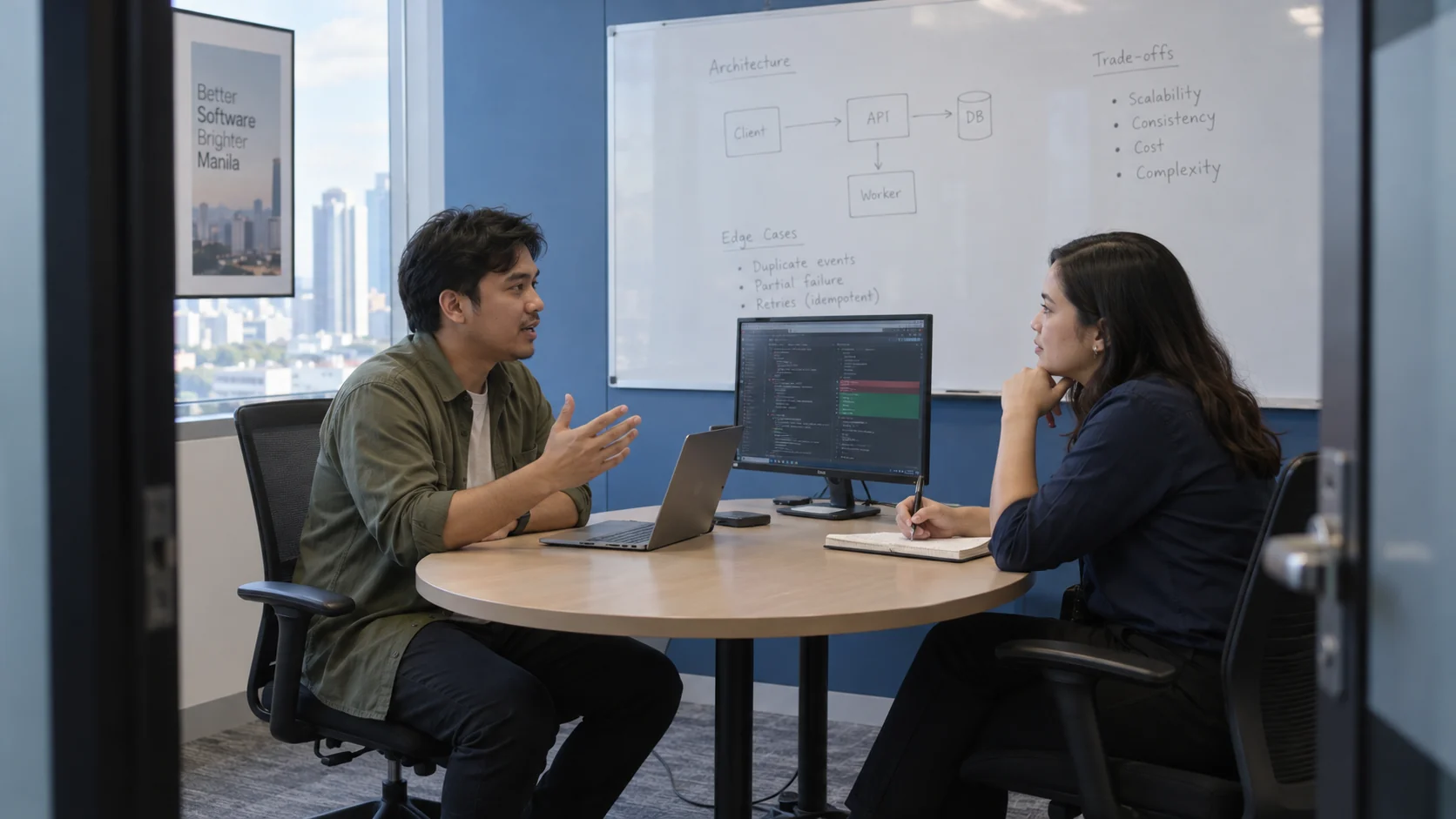
Your team has just interviewed a developer for a React, Node.js, and PostgreSQL role. They improved a small interface change and explained their work clearly. The call ended before anyone examined the API or database behavior. Would you move forward?
For a frontend opening with backend support, you might have enough evidence to continue. For a full-stack role requiring independent API work, you still have an important question to resolve.
A useful offshore developer interview connects the responsibilities of the opening to work you can observe. Combine a relevant project discussion, a small representative change, and a written handoff. Record what the candidate demonstrated and what remains unknown before making your hiring decision.
This guide works backward from that decision. The example candidate, application, and assessment below are fictional; the interview format is a proposal you can adapt to your own team.
Start with the question the interview left unanswered
Suppose a US software team needs someone to maintain a customer-support dashboard. The engineer will deliver changes across the interface and API, add relevant tests, and leave review notes for teammates working at different times.
After the fictional interview, the team records this:
Responsibility
Evidence from the session
What the team still needs to know
Interface behavior
Candidate made a failed request visible to the user
Whether the fix handles a later successful request
API and data work
Candidate described the request path
Whether they can implement the server-side change and preserve workspace access rules
Verification
Candidate ran a component test
Which server behavior was checked and which was not
Written collaboration
Handoff separated completed work from an outstanding question
Whether the agreed working schedule is sustainable
The next step should address a specific gap. For this opening, arrange a focused API and data discussion or exercise. If backend ownership was never required, revisit why it became a hiring condition.
This distinction also matters when a provider has already screened a candidate. Ask what the assessment covered and which evidence your own team should still collect. An overall recommendation cannot tell you whether every responsibility of your opening was examined.
Map the role to evidence before meeting candidates
Write a short description of the first responsibility the engineer should be able to own. For the dashboard role, that might be:
Improve existing support workflows across React, Node.js, and PostgreSQL, with a senior engineer available for review. Investigate user-reported issues, check changes, and document anything another teammate needs to continue.
Specify the balance of frontend, API, data, and infrastructure work. Also name the reviewer and product decision-maker. A role with regular senior guidance calls for a different assessment from a role expected to make architectural decisions alone.
Then choose evidence for the essential requirements:
Requirement
Evidence to seek
A useful boundary to record
Understand the request
Explains the user's problem and clarifies an uncertain requirement
Understanding this task does not establish knowledge of your whole product
Reason across the stack
Traces interface state, request handling, and relevant data rules
Discussing a path does not prove the candidate can change it correctly
Implement and verify
Makes a bounded change and checks the intended behavior
A component test does not establish server authorization
Make technical decisions
Explains scope, alternatives, and remaining risks
Confidence alone does not establish independent senior-level judgment
Share work
Leaves a note another engineer could act on
A clear handoff does not settle availability or schedule fit
Define what meets, partly meets, does not meet, and not observed mean for each essential requirement. Ask the same core questions and apply the same standards to candidates for the same opening, while using follow-ups to understand individual answers. The US Office of Personnel Management's structured-interview guidance explains this consistent, job-related approach.
Separate skills needed on arrival from skills your team will teach. Keep sourcing and provider selection in a separate conversation; our guide to finding and hiring offshore software developers covers those earlier decisions.
Follow one change from the screen to the handoff
Use a small interview repository with synthetic data and a working starting point. The task should resemble work the person would do: OPM's guidance on work samples describes representative tasks and emphasizes skills expected when entering the role.
For the fictional dashboard, support agents need a status filter on their ticket list. A proposed change adds the filter, but a failed request leaves old results visible without explaining what happened.
Provide the component, API handler, query function, existing authorization helper, and a small set of tests. Explain that agents may see tickets only within their authorized workspace. Keep the materials small enough to read together, and answer questions about application conventions.
Trace behavior before changing code
Ask the candidate to follow one selection through the application:
Which interface state changes when a status is selected?
What does the API validate, and where does it establish the permitted workspace?
How does that workspace restriction reach the query?
What will the agent see if the request fails or two responses arrive out of order?
Use their explanation to choose one bounded improvement. The candidate might clarify the failure state while preserving the label associated with the last successful results. For a balanced full-stack opening, examine the server path too; a frontend change alone will not expose all the required skills.
Check a behavior that could be wrong
Ask for a check that distinguishes the original problem from the intended behavior. Discuss the result and its limits. Did the candidate demonstrate the error message, the recovery path, or the API's access boundary? Those are different observations.
Google's public code-review guidance offers useful prompts about design, functionality, complexity, and tests. Apply those prompts to the change in front of you. Avoid rewarding an impressive list of testing terms without examining what a check actually proves.
Leave a note for the next engineer
Ask the candidate to summarize the change, the checks completed, what remains unresolved, and the next action. One hypothetical handoff is:
Added a visible error when filtering fails. Existing tickets stay labeled with the last successful filter. The failed-request component test passes. I have not checked workspace scoping in the API. Before release, review that query path and add a cross-workspace test.
This note gives the reviewer a concrete starting point. It also exposes an evidence gap the interviewers should retain in their assessment. Microsoft's asynchronous collaboration checklist recommends including a short pull-request description and steps to validate the work. That is a useful model for the handoff. Written collaboration matters when colleagues work at different times, but schedule expectations need their own explicit conversation.
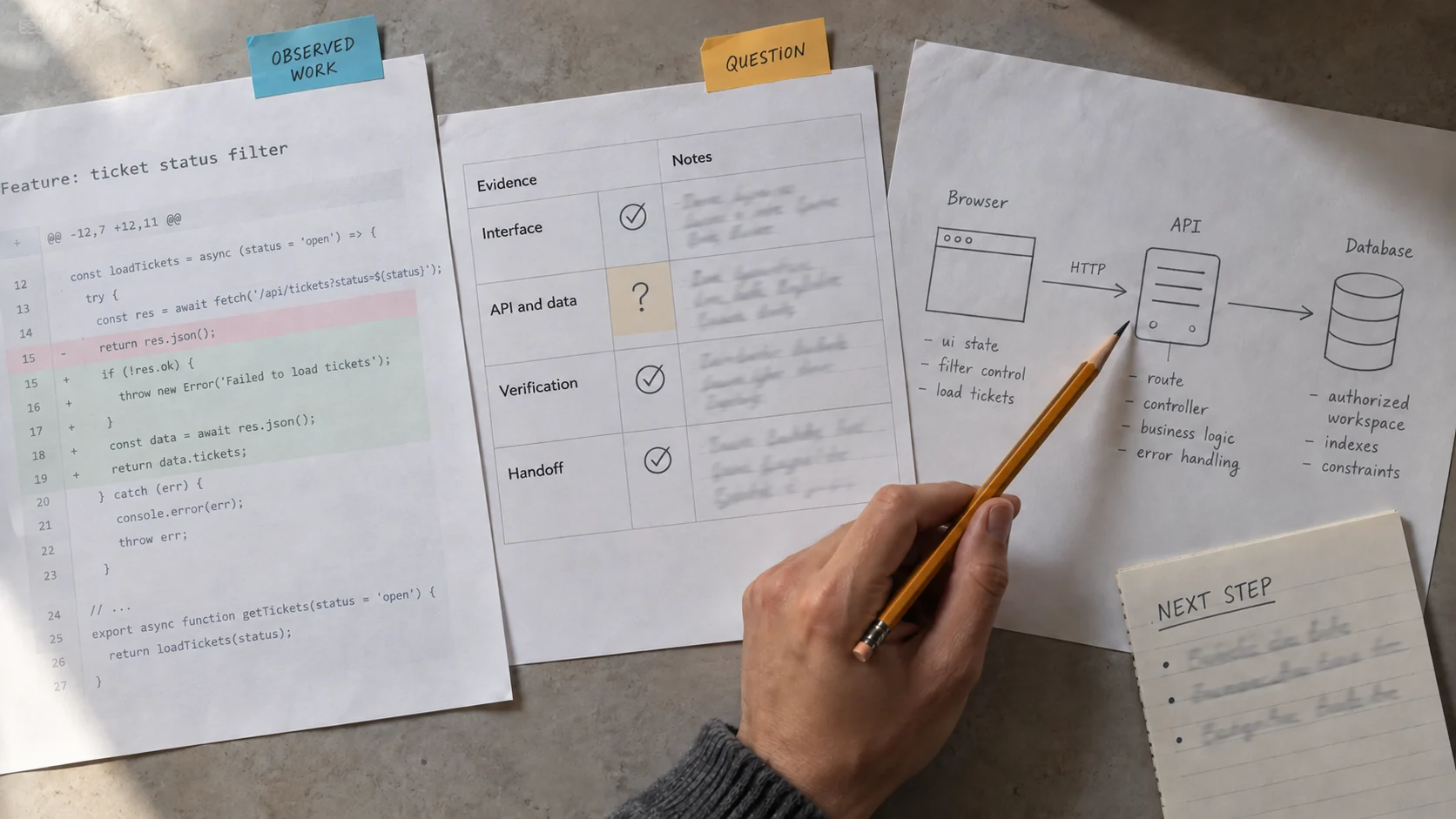
Illustrative assessment materials separate observed work from an unresolved API question. Images in this article are AI-generated illustrations of fictional people and materials, not actual Arca interviews or candidate records.
Agree on preparation, timing, and tools
Explain the format before the interview, including assessed skills, setup, time allowance, permitted resources, and any preparation. Try the exercise internally and leave room for questions or setup trouble. Offer an appropriate adjustment when needed.
For the example role, a 60-minute session could use this agenda:
Activity
Suggested time
Intended evidence
Discuss a relevant project
10 minutes
Personal contribution and decisions
Read the proposed change
15 minutes
Request flow, assumptions, and questions
Improve and check one part
20 minutes
Implementation and verification
Write the handoff
5 minutes
Context another engineer can use
Candidate questions
10 minutes
What the person needs to understand about the role
This timing is a suggested starting point, not a validated assessment. A senior opening may need additional evidence about architecture, operations, or broader ownership. Keep any separate assignment bounded; agree on scope and compensation if it involves substantial work. Do not use confidential customer work as the test.
Make the AI policy concrete. For example:
Documentation and AI coding tools are allowed with the sample materials. Explain what assistance you used, review its output, and be prepared to change or verify the result. Describe your own contribution when discussing previous projects.
If part of the session must be unassisted, state that in advance and explain what it assesses. Apply the announced policy consistently. Permitted tool use should lead to questions about understanding and checking the output; it should not become an accusation of dishonesty.
Use project questions to resolve a different kind of uncertainty
The exercise shows a short piece of work under interview conditions. A project discussion can help you understand a candidate's previous responsibilities, decisions, and response to consequences over time.
Choose a project relevant to the opening. Accept a sanitized account when code or customer details are confidential. Follow one claimed contribution:
What did you personally change?
Which decision did you make, and what alternatives did you consider?
How did you know the change worked?
What happened after release, and what would you do differently?
For example, if someone describes improving a slow dashboard, ask how they identified the bottleneck and compared the result. Distinguish work they performed from work another teammate owned. Avoid expecting a polished story to substitute for an essential skill that has not been examined.
Choose any additional coding test for the capability it assesses. An algorithm exercise may be relevant to a role with substantial algorithmic work. It leaves other questions open, including how someone works with an existing application, reviews a change, or coordinates with teammates. Neither a strong test result nor an engaging project story should answer an unrelated requirement by implication.
Close the interview with an evidence-based next step
Have interviewers record observations before the group debrief. For each essential requirement, retain the assessment and the concrete evidence behind it. Keep not observed separate from does not meet.
Return to the opening example. The candidate's interface change and written note are useful evidence. The team still needs to examine backend capability for a role that requires it. A short follow-up can cover that responsibility without repeating the entire session.
If the next step is unclear, write the decision in three sentences:
We observed ____. We still need evidence of ____ because the role requires ____. Our next step is ____.
Also distinguish capability from the working arrangement. Confirm required collaboration windows, access to technical guidance, and who resolves product questions. An interview cannot establish whether an unspecified schedule or unsupported role will work well.
This approach produces a defensible record of what you learned. It does not guarantee performance, and the proposed exercise and criteria should be adapted and reviewed for your actual opening.
Bring the responsibilities and evidence gaps from your hiring brief to a discovery call. Ask what candidate assessment covered, what your team should explore next, and what technical support the engineer would have after joining.
Common questions
Should an offshore developer interview use a different technical standard?
Set the standard from the job's responsibilities and seniority. Evaluate collaboration requirements as well, including written context and agreed availability. Location alone does not establish technical capability or working fit.
How should we handle AI tools during the interview?
Publish the rules beforehand. When assistance is allowed, ask the candidate to explain, verify, and modify the result. If an unassisted segment is needed, explain its purpose and apply the same rule to everyone interviewing for that opening.
What if nobody on our team can assess the technical work?
Arrange for an engineer qualified in the relevant work to review the evidence and explain their findings. Ask what was demonstrated, what remains uncertain, and what support the candidate would need. Consider the technical supervision available after the person joins as well.
Does a candidate have to finish the exercise?
Define what must be demonstrated in advance and keep the task achievable. Distinguish a missing skill from setup trouble or an oversized task. Discuss unfinished work and its next steps; completeness is one part of the evidence.